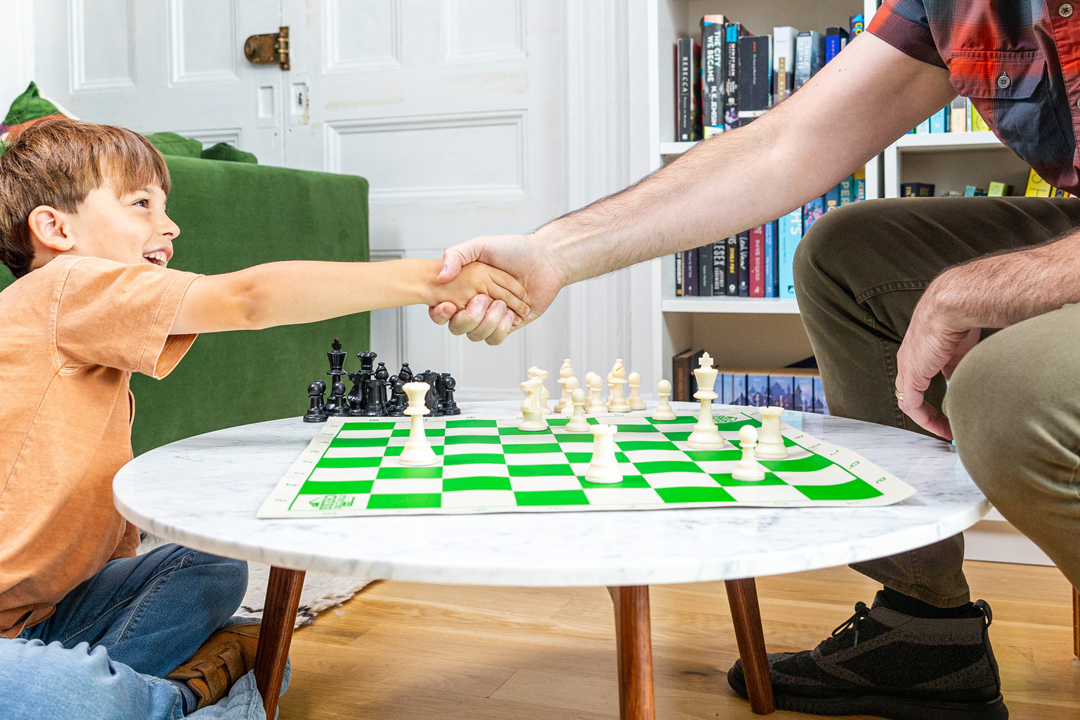



One minute, they're happily playing chess.
The next? Their queen gets captured, the tears start flowing, and they're announcing their retirement from chess at the ripe old age of five.
It was a promising career while it lasted.
If you've ever watched your child completely unravel over a board game, congratulations! You've witnessed one of childhood's great emotional milestones: discovering that things don't always go according to plan.
And if you've ever found yourself negotiating with a crying child over the fate of a plastic chess piece, you're in good company.
Here's the thing. Losing is hard. Especially when you're little, you've worked really hard, and your opponent (who may or may not be your own mother) has just delivered a devastating checkmate.
But learning to lose is one of those life skills that children have to develop eventually. Preferably before they're adults arguing with a self-checkout machine.
The good news? Chess happens to be a pretty wonderful place to practice.
To an adult, losing a board game is mildly disappointing. You shrug, congratulate the winner, and move on with your life.
To a five-year-old, losing a board game can feel like a deeply personal betrayal.
Young children are still developing the ability to regulate their emotions, tolerate frustration, and separate their performance from their sense of self.
In other words, when they lose, they aren't necessarily thinking, "Hmm, perhaps I should have protected my bishop."
They're thinking, "I'm terrible at chess, my life is ruined, and I never liked this stupid game anyway."
Dramatic? Sure.
Developmentally understandable? Also yes.
Children can have a hard time distinguishing between "I made a mistake" and "I'm bad at this." And when those two ideas get tangled together, losing can feel much bigger than the game itself.
That's why teaching children how to handle defeat isn't really about teaching them to be good losers.
It's about helping them understand that making mistakes, feeling disappointed, and not being the best at something are all perfectly normal parts of being human.
An inconvenient truth, but an important one.
When your child starts crying over a lost game, your first instinct is probably to make them feel better.
Naturally, this means saying the exact thing they don't want to hear.
"It's just a game!"
A reasonable observation. Unfortunately, your child has just experienced what they believe to be the greatest injustice in recorded history, and they are not interested in your perspective.
Or perhaps you've tried:
"Don't cry! You'll win next time!"
Which is lovely, except you can't actually guarantee that. And your child may remember this promise when they lose again seventeen minutes later.
The trick isn't to convince children that losing doesn't matter.
It's to help them understand that they can feel disappointed without letting that disappointment take over.
Here are a few small changes in language that can make a surprisingly big difference.
Try: "I can see you're disappointed. You really wanted to win."
You're acknowledging their feelings without agreeing that the situation is, in fact, a national emergency.
Try: "It's okay to feel frustrated. Let's take a minute before we figure out what happened."
Sometimes children need a little time before they're ready to talk about what went wrong.
And sometimes you need a minute, too.
Try: "What do you think you could try differently next time?"
This gently moves their attention away from the result and toward something they can control.
Try: "That was a tricky move! Want to see if we can figure it out together?"
Because nothing helps a frustrated child quite like being informed that their mistake was obvious to everyone else in the room.
The goal is simple: acknowledge the emotion, give them room to recover, and help them see that a mistake is something they can learn from.
Not something they need to carry around for the rest of the afternoon.
Here's something interesting about professional chess players.
They lose, too.
Quite regularly, actually.
The difference is that when a Grandmaster loses a game, they don't typically declare that chess is stupid, flip the board, and retreat to their bedroom.
At least, that's not the recommended approach.
Instead, they often do something called post-game analysis.
It's exactly what it sounds like. Players go back through their games, identify important moments, and figure out what they could have done differently.
They study their mistakes.
On purpose.
Imagine that.
And while your child probably isn't ready to spend three hours reviewing a questionable pawn move, there's a much simpler way to introduce the same idea.
We call it The Chess Detective Challenge.
Once the tears have dried and everyone has agreed to remain in the same room, ask:
"Can you remember one move that surprised you?"
Maybe their queen was captured. Maybe they forgot to protect their king. Maybe their opponent did something completely unexpected.
Whatever it was, help them identify one moment worth looking at.
You're not conducting an investigation into who is responsible for the loss. You're simply finding a clue.
Now ask:
"What else could we have tried?"
Set the pieces back up and experiment with a different move.
What happens if the queen moves here instead? What if we protect the rook? What if we don't send the king directly into danger?
An interesting concept.
The goal isn't to find the perfect move. It's to show children that there are often different ways to approach a problem.
And that discovering those alternatives can actually be fun.
Finally, ask:
"What's one thing you want to remember for our next game?"
Maybe it's checking whether a piece is protected.
Maybe it's taking their time.
Maybe it's remembering that their opponent is also allowed to make good moves. A difficult reality to accept, but an important one.
That's it.
One mistake. One discovery. One thing to try next time.
The game still ended in a loss. But now your child has something they didn't have before: a little more knowledge and a reason to try again.
Which, if you ask us, is a pretty good outcome.
As parents, we're pretty good at measuring progress.
We track grades, goals, milestones, growth charts, and approximately fourteen different school spirit days.
But some of the most important signs of growth are a little harder to measure.
Especially when it comes to resilience.
Resilience isn't about never getting upset. It's about gradually learning how to work through challenges, recover from disappointment, and keep trying when things get difficult.
And the signs that your child is developing these skills aren't always obvious.
Sometimes, they're very small.
1. They stayed at the board.
Last week, losing a queen resulted in an immediate resignation and a formal announcement that they hated chess.
This week, they took a breath and kept playing.
Progress.
2. They asked for help.
Instead of giving up, they asked, "Can you show me how to do that?"
A small question. A big step.
3. They tried something different.
Their first strategy didn't work, so they came up with another one.
Was it a brilliant strategy? Perhaps not.
Did they try? Absolutely.
4. They recovered a little faster.
Maybe there were still tears. Maybe they still needed a break.
But this time, they were ready to play again after five minutes instead of twenty.
We'll take it.
5. They wanted a rematch.
They lost. They were disappointed. They survived.
And now they're asking to play again.
Possibly because they're convinced they can beat you this time.
Regardless of their motivation, that willingness to try again is worth celebrating.
These little moments are what we like to call resilience wins.
They're not formal milestones, and there's no need to start keeping a spreadsheet. You probably have enough of those already.
They're simply reminders that progress doesn't always look like a trophy, a perfect score, or a victorious child raising both arms in triumph.
Sometimes, progress looks like a kid who loses a game and decides to keep playing anyway.
Well, sometimes they will.
You can say all the right things, offer all the right encouragement, and gently introduce the Chess Detective Challenge.
And your child may still inform you that they are finished with chess forever.
That's okay.
Not every difficult moment needs to become a teachable moment right then and there.
Sometimes the best thing you can do is give your child a break.
Try saying:
"We don't have to play anymore right now. I know that was frustrating. Whenever you're ready, we can try again."
No lectures. No forced rematches. No inspirational speeches about perseverance while they're still crying into the couch cushions.
Just a little space.
When they're ready, you can always start small. Instead of playing another full game, try a quick chess mini-game with just a few pieces.
Smaller challenges can help children rebuild their confidence without feeling overwhelmed.
And if they don't want to play again that day?
The chessboard will be there tomorrow.
Unlike the snack you left unattended on the kitchen counter.
Here's the thing about childhood.
Eventually, your child is going to lose something that matters a lot more to them than a chess game.
They might not make the team.
They might struggle with a subject in school.
They might audition for the school play and end up playing Tree Number Three.
A very important tree, obviously. But perhaps not the role they were hoping for.
We can't make sure our children win every game, get every opportunity, or avoid every disappointment.
And as much as we'd sometimes like to, we can't swoop in and fix every difficult situation for them.
What we can do is give them opportunities to practice handling those moments while the stakes are still relatively small.
That's one of the things we love most about chess.
Every game is full of little decisions, unexpected challenges, and opportunities to try something new.
Sometimes things work out.
Sometimes they don't.
And sometimes your queen gets captured because you were too busy planning an elaborate attack to notice the bishop sitting three squares away.
It happens.
At Story Time Chess, we use stories, imaginative characters, and playful challenges to help children explore these lessons in a way that feels approachable and fun.
Because while we're teaching children how to play chess, we're also helping them practice patience, problem-solving, confidence, and perseverance.
Skills they'll carry with them long after the pieces are packed away.
The goal isn't to raise children who never lose. It's to raise children who know that losing isn't the end of the story.
Even if, occasionally, they insist otherwise.
At Story Time Chess, we believe some of life's biggest lessons can come from the smallest moments.
Through storytelling, play, and age-appropriate chess instruction, we help children build skills that go far beyond the board.
And yes, sometimes that includes learning how to lose a queen without declaring a family-wide emergency.